Why Agentic AI is a stack-not a single tool
A simple LLM application can look like User → Prompt → LLM → Answer. A useful agentic system is usually more involved: it may retrieve company knowledge, search the web, call APIs, query databases, remember state, evaluate its own work and trigger business actions.
That means learning “the best AI tool” is less useful than understanding which layer solves which problem. The 70 tools below are grouped accordingly.
Table of Contents
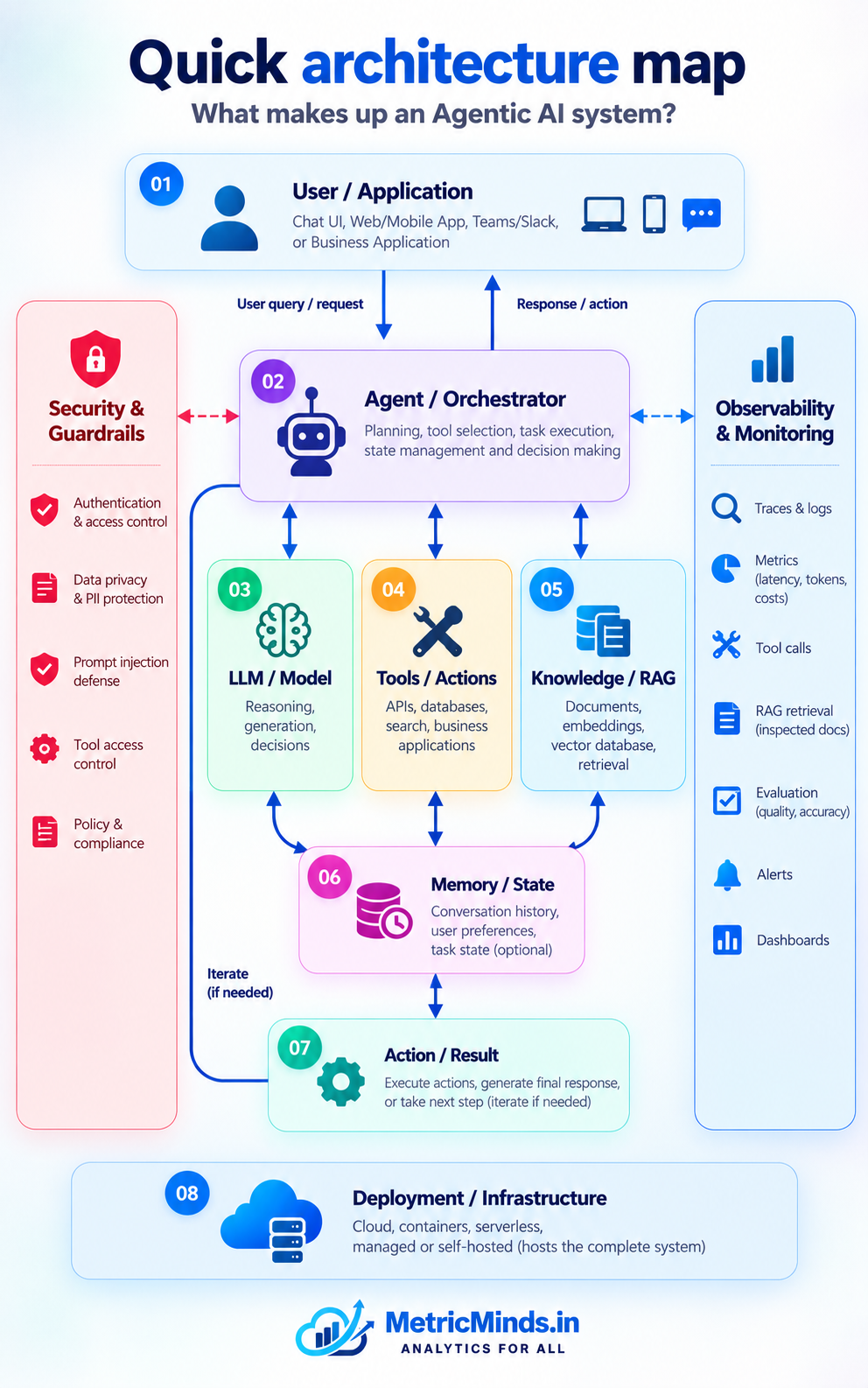
Quick architecture map
A visual breakdown of what makes up a complete, production-grade Agentic AI system.
LLMs / Foundation Models
Reasoning, generation and multimodal AI.
Gemini
Groq
OpenRouter
Mistral
Hugging Face
Cloudflare Workers AI
Ollama
Embedding Models / APIs
Turn content into vectors for semantic search and RAG.
Google Gemini Embeddings
Voyage AI
Jina AI
Cohere
Hugging Face
Ollama
Sentence Transformers
Vector Databases
Store and retrieve embeddings efficiently.
Workflow / Automation
Connect agents to APIs, applications and business workflows.
Agent Frameworks
Build planning, tool use, state and multi-step agent behaviour.
LangChain
LangGraph
CrewAI
AutoGen
Microsoft Agent Framework
Haystack
LlamaIndex
Visual Agent / RAG Builders
Build agents and RAG workflows with less code.
Dify
Flowise
Langflow
AnythingLLM
Botpress
RAGFlow
Open WebUI
Web Search / Research / Retrieval
Give agents current information and web-reading capabilities.
Tavily
Serper
Brave Search API
Exa
Jina Reader
Firecrawl
SearXNG
Memory / State / Databases
Store conversations, user state, tasks and business data.
Supabase
Firebase
Redis
MongoDB Atlas
Neon
PostgreSQL
SQLite
Observability / Tracing / Evaluation
Understand what agents did, why they failed and what they cost.
Langfuse
LangSmith
MLflow
Arize Phoenix
Helicone
OpenTelemetry
Splunk Observability
Deployment / Hosting
Run and expose your agent or application.
Vercel
Cloudflare Workers
Render
Railway
Hugging Face Spaces
Streamlit Community Cloud
GitHub Pages
Free is a starting point-not a production strategy
The free/open-source ecosystem is one of the best things about learning Agentic AI today. You can build meaningful experiments without first buying an enterprise stack.
But free does not mean free for a client production deployment. Production introduces API consumption, rate limits, infrastructure, security, privacy, licensing, monitoring, reliability, backups, support and potentially SLA requirements.
A practical starter stack
If I were starting today, I would not try to master all 70. I would build one working stack around Gemini or Groq + n8n + LangGraph + Dify + Qdrant/Pinecone + Supabase/PostgreSQL + Tavily/Firecrawl + Langfuse + Cloudflare/Vercel, while using Ollama to understand local AI.
“Don't learn 70 AI tools. Learn where they fit.”
The technology will keep changing. The architectural thinking will remain useful.
Note on the list: “Free” status is indicative rather than a guarantee of unlimited use. Hosted providers frequently change quotas, credits and plan conditions. Open-source/self-hosted software may be free to license while still requiring your own compute, storage, networking and operational effort.